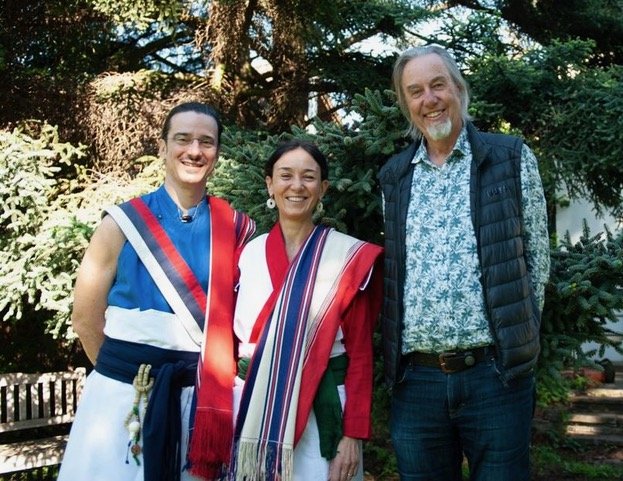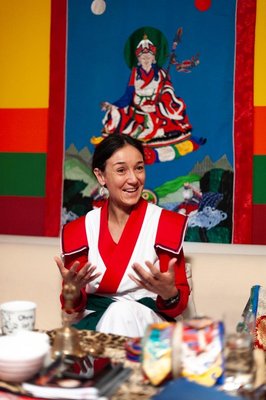

The interview below was published in the Austrian Buddhist magazine Buddhismus in Österreich (issue 07–09/2026). In it, Ngakma Déwang Pamo discusses the white sangha and how serious practice, work, and family life can be brought together.
Photos: Ida Kronika · Text: Johannes Kronika
ÖBR: Dear Déwang Pamo, how did you come to the Buddha's teachings?
Déwang: Fortunately, at a young age. My interest in Buddhism developed slowly from my youth onward. In the '90s, I took refuge at the Buddhist centre in Scheibbs — Matthias will still remember me. That's where I encountered the Aro gTér, simply because I happened to be at the centre at the time. I called Matthias and asked whether I could come in the summer. He told me there was a group on summer retreat just then; I went along, and that was it.
At the beginning, of course, everything was still very new and very unfamiliar. But I also noticed that it touched me somehow, that I felt at ease there, that I wanted to get to know these people better, that this teaching was something that interested me. My grasp of the content wasn't very clearly developed yet, of course — there were mainly a lot of question marks.
ÖBR: Do you still remember who led the group back then? Was it an Austrian?
Déwang: No, the lamas of our lineage were mainly based in Britain at the time; there were no German-speaking teachers yet. We are now the first to teach in German in the German-speaking world. The authorisation to teach also only came a few years after we had taken the tantric root vows and were ordained. Not all ordained practitioners teach. First and foremost, it requires the encouragement of the lamas and, of course, the appropriate preparation and training. It's about study, practice, retreat, the commitments one takes on, and above all the close connection with one's own lamas, who then decide when it's time to begin teaching and to accept students of one's own.
That was quite a challenge for me at the beginning, too. I still remember that our first daughter was very small at the time. She was four months old; I was holding her in my arms when our lamas first said it would be good for us to begin teaching. I thought, "For heaven's sake, how is that supposed to work?" And then our second daughter came along. Yes, that's how it began.
ÖBR: So you've practised in the Aro gTér lineage from the very beginning. Did you also look into anything else — Theravada, Zen?
Déwang: Yes, I did. Openness and friendship with other schools and lineages are very important. We also encourage our students to look at other teachers and teachings. You just have to be careful that it doesn't end in great confusion — because Buddhism, as we know, is beautiful in all its diversity, but that diversity also poses a potentially great challenge.
And that's why it's good to have teachers who accompany you and help you make sense of it all — to understand the different vehicles and also to see the perspective the teachings come from. And then it all makes sense. When I understand how to place something, how it fits together, then it's a very enriching experience. I greatly value dialogue with other practitioners and teachers. Experiencing different views and methods of practice in a positive way, and developing an understanding of them — I owe that to my lamas. I find that very helpful.
Often the perspective from which one regards a phenomenon is decisive, because it usually carries unspoken assumptions with it, and so one should try to understand as well as possible the particular perspective from which something is being explained. Our terms and categories often capture only parts of a broad spectrum, from one very specific vantage point. And there are always other ways of approaching things.
Practice as a family matter
ÖBR: How did you come by your nun's name?
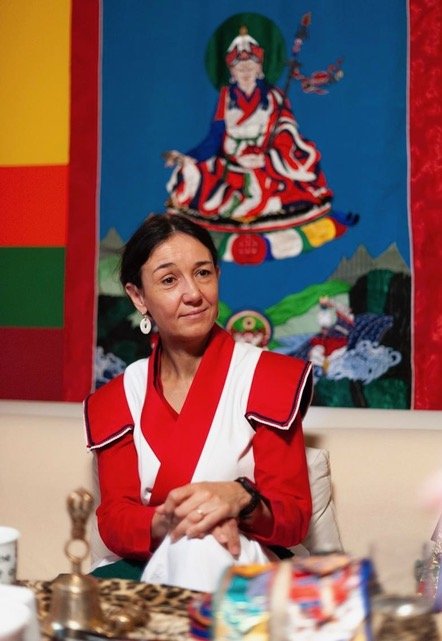
Déwang: I'm definitely not a nun — I'm married and have children. My name is a Vajra name, the kind we receive in the lineage when we take tantric vows, when we are ordained, but not as a monk or nun — rather as a ngakpa or ngakma (sNgags pa or sNgags ma / mantrin or mantrini). Ngakma is the female form. This is an important subject, and that's why it's good that we're talking about it. The Aro gTér is a lineage within the so-called "white sangha," in Tibetan Gö kar chang lo'i de (Gos dKar lCang lo'i sDe). Gö kar (Gos dKar) means "white robe," chang lo (lCang lo) "long, uncut hair." De (sDe) means assembly. This is a lineage of practice that is not oriented toward life in a monastery, and not celibate.
The Catuṣpariṣatsūtra already describes four sanghas: the monks, the nuns, and also the male and female non-monastic practitioners. In Indian Buddhism there were realised practitioners outside the monasteries as well — think of the Mahāsiddhas, for instance, or of Vimalakīrti. In Tibet, the white sangha was introduced by Padmasambhava. It's important to me to say clearly here that I have a great deal of appreciation and respect for the monastic path. It's wonderful when someone is able to walk that path.
At the same time, it is also an important concern of our lineage to make the white sangha visible, to make this path of non-monastic practice known — and to do so on behalf of Düd'jom Rinpoche [Kyabjé Düd'jom Rinpoche Jigdral Yeshe Dorje (1904–1987), a lama of extraordinary realisation who presided over the Nyingma tradition after the exile from Tibet]. Our lama, the lineage holder of the Aro gTér, Ngak'chang Rinpoche [Ngak'chang Rinpoche was born in 1952 in Hanover, Germany, the son of an English father and a German mother], was ordained as a ngakpa by Düd'jom Rinpoche and received the robes from him. Düd'jom Rinpoche gave him the instruction — or rather had him make the promise — to carry on the lineage of the Gö kar chang lo'i de.
Düd'jom Rinpoche himself was not a monk either, but a member of the white sangha. This surprises people again and again, because some imagine a high lama must be a monk. But he was a married man with — believe it or not — eleven children. My academic work at the University of Vienna currently revolves around Düd'jom Rinpoche's diary, which I have the privilege of translating — a fascinating project. In his diary he also mentions his wife and his children. This is clearly not a part of his life that he pushes aside or hides, or where the impression arises that — heaven forbid — it somehow distracts him from his practice. He was held in high regard, one of the most important Tibetan lamas of the 20th century, and he combined his practice with his family life and his work as a lama, scholar, author, and editor of important text collections.
So this compatibility of practice, family, and profession is not something newly invented here in the West today; it is something that has existed for a long time. It simply didn't become so well known, because in the Nyingma tradition in particular it was always rather small family lineages, which simply weren't that visible. Of course, the Nyingma school also has its great monasteries and monastic lineages. And, as I said, we are connected to those lineages in friendship and respect. At the same time, the non-monastic path is one that, I believe, can be very helpful for all of us right here and now.
When I talk with the people I meet at our talks or on retreats, there are many who have a career and a family and therefore feel: I can never get anywhere in my practice, I just can't manage it. And many of them then give up. Especially people with demanding professions, mothers and fathers, who at some point say, it's too much for me, it can't be done. That often comes from the fact that an understanding of practice, or even specific practice methods, which actually come from the monastic environment and are well placed there, often can't be implemented quite so easily in a life outside the monastery. It can help to learn an approach and methods of practice that take a life like ours as their basis — where it's also a matter of earning a living and, in a relationship or a family, getting through the everyday madness without losing sight of the joy of life.
It is a great concern of our teachers, and therefore of ours too, to make this path of practice known and to keep the promise made to Düd'jom Rinpoche. I feel it to be a great privilege and a great opportunity that we can say: family, career, and serious practice — they go together. With us the children are part of it too; they're allowed to be present at the retreats, which often surprises people. What, I'm allowed to bring my child to the retreat? Isn't that disruptive? We almost always took our own children along; I had them lying on a blanket on the floor next to me as babies. Now, this may not be everyone's cup of tea, of course, and that's fine too. But I think it's very important to demonstrate that practice can be a family matter, and that's something beautiful.
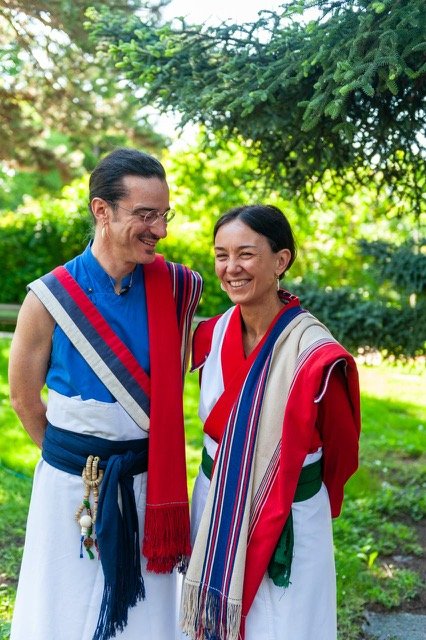
It's not just about children, but about intergenerational harmony. At our retreats, you'll often find people of all ages. We have older adults, middle-aged people, teenagers, and children. To me, this is something I find very enriching and very important. Because the more we treat each other with kindness, respect, and humor within our families, the more harmony and peace begin to take root in the world. I was thinking about this just last week when we were at the Eurovision Song Contest. There was that Interfaith Pavilion at the Song Contest, and yes, it's about diversity and coming together across borders.
But that starts on a small scale — it really starts at home. It also starts in a relationship; in our tradition, this plays a major role. We have an entire body of teachings centered on the practice within romantic relationships, and for single people, this also involves the universe as a partner. We teach as a couple, our lamas teach as a couple, and the Tibetan lamas of our lamas were known to be couples. Düd'jom Rinpoche would sometimes say to a student, "Go to my wife and ask her; she knows better. She can help you with this better than I can." There are other examples like this in the history of Tibetan Buddhism, though they aren't very well known. I am happy and grateful to be able to talk about this, in the hope that it will encourage practitioners.
Professional life and a teacher's practice united in the Aro gTér lineage
ÖBR: Would you like to tell us a little more about the white sangha?
Déwang: May I get a bit historical, simply because the topic really interests me so much? There are often misunderstandings and misperceptions that rest on the fact that we naturally need terms and categories to make sense of the world around us. Some people say, but there are married monks in Tibet, how can that be? It gets seen as a distorted, corrupt form of practice. In fact, though, there are intermediate stages on the path to full monastic ordination where, for example, one doesn't yet have to live celibately — that's one aspect.
The second is that we also know from the texts of the Vinaya that a monk's or nun's life was not always strictly bound up with actually having to leave behind everyone and everything, permanently, when one entered the sangha, all on one's own. Buddha Shakyamuni himself was not cut off from his family within his sangha. Ānanda was his cousin, there were other cousins, there were his son, his wife, his stepmother — they all became members of the sangha. So he had his family around him again.
If you really study the texts of the Vinaya — and fortunately there are colleagues who really know this area very well — then you see that sometimes partners entered together, or a parent entered the sangha together with a child. These are passages one doesn't normally read, that one overlooks, because of course we've taken a rather selective look over all these texts. But evidently this "going forth," taking refuge, entering the sangha, was indeed something compatible with a life within a certain family bond.
There are also individual documents showing that some monks and nuns continued to hold property that they had to manage. They tilled fields, looked after their herds; they did have a kind of professional life, or economic matters, to attend to. Life in the monastery had to be organised, after all. Some also lived at home and not continuously in the monastery. And to this day there are monks and nuns who stand in the world and engage actively.
We often think there's only this one Buddhist ideal, and that it's the monastic life — shaped a little by the Benedictine idea, with our cultural and religious background in mind. But if you look more closely, a much more colourful picture emerges of the various forms of serious Buddhist practice, a much more open picture, also with regard to the different life circumstances of the members of a sangha. And I really do think that Buddhism often was, and is, more family-friendly than we might suppose. That's a beautiful thing. I read these things, I study them, and I always think to myself: hey, there's still a lot to discover here!
There's also a lot we don't yet understand. Reality is always more complex than our categories. We need categories to find our bearings in the world, but reality effortlessly fills the spaces in between as well. I think it's good to make oneself aware of that. That's why it's important, alongside practice, not to neglect study. Here in Austria we have the great good fortune that one can study Tibetology and Buddhist Studies at the university in Vienna. If you learn the languages, you can read the texts in the original and form your own opinion. That's incredibly valuable.
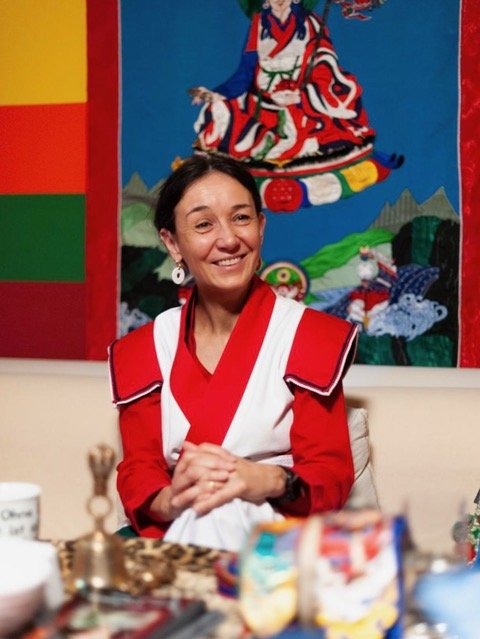
Practising with our feelings, with our perception, with our experience in the world
ÖBR: You've already answered a question I wanted to put to you — how one unites a career with a teacher's practice. And that seems to be very possible in the Aro gTér lineage. You lead retreats, you give introductory courses, you do research at the university, and you're a Dharma teacher together with your husband. From your perspective, what are common misconceptions that practitioners of the Dharma come up against, at the beginning?
Déwang: I've already mentioned one major misconception. That feeling that it's always only second best if I can't manage to take the monastic path, then I've actually already failed before I even begin. It matters a great deal to me to encourage people and say, there is also a path of serious practice beyond the monastery. And you can look around; we're not the only ones. There are plenty of opportunities to inform yourself, to take heart and say, I want to practise and I'll simply try to find a path for myself, right here and now.
Another widespread misconception is that many believe Buddhism is detached from the world, not very life-affirming, emotionless — I've touched on that too. There's this misunderstanding that one ought not to have feelings, that one should cut oneself off from one's feelings. Our view — and this view is rooted in tantric Buddhism and in Dzogchen — is that feelings are not only permitted and important, but that they also open up a method of practice. By practising with our feelings, with our perception, with our experience in the world, we can, within that experience and through that experience, realise the natural state of our mind.
In that sense, art and creativity also play a major role for us, for instance. It's about going through the world with open senses and not only withdrawing. Withdrawal — group or individual retreats — is of course something very valuable, and in our lineage too it's an essential part of practice. I just want to stress that there is, complementarily, an aspect turned toward the world as well. And the two do not exclude one another. Buddhism is a religion of method, and of the diversity of methods. It is not simply a religion of the one truth that can be attained in only one particular way. There are so many possibilities.
And I see how people blossom when they really set out on the path. Physical exercises, dances, and song are an important part of practice. We also encourage our students to turn to art and craft. Some people begin to paint, to work with wood or with leather. One of our students builds drums. Many take up sewing, because of course you can't simply buy our robes, all our practice gear, somewhere. They're sewn by hand.
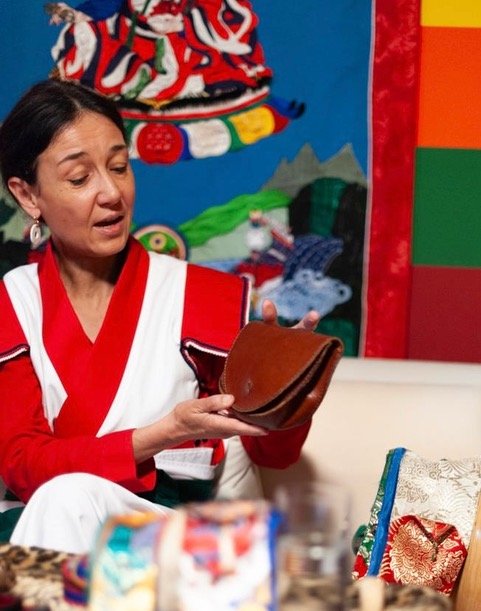
Another Vajra brother, for instance, made this leather bag for me. So there are people who work with these materials and, through that, discover that there are many ways to experience the world in a liberated and wakeful manner — through art and craft, through this integration of the senses, of the sense fields, into practice. And really, that leads to awakening, it leads to more joy in life. That, I believe, is something we desperately need.
And here we come to the next misunderstanding: Buddhism is serious and joyless. Buddhism isn't necessarily associated with the positive sides of life. In our lineage, though, we also practise Gatön (dga' ston), for example. This is a practice where we celebrate together. There's singing, dancing, the recitation of a poem, a lot of laughter. It's a joyful coming-together, with a festive meal as well.
And these are aspects of practice that, I believe, do us a great deal of good precisely here and now. To allow ourselves to be glad, to celebrate our good fortune in having a religious home, in being able to practise, beyond that "I'm-not-good-enough." I think we all know it. One compares oneself constantly. Everyone else is happy, only I'm not. Everyone else has the perfect body or the perfect life. Only I don't. What am I doing wrong? We practise as we are, and that gives our life meaning.
Václav Havel once wrote, in essence, that hope is not simply optimism that says everything will turn out fine. Hope is the conviction that what I'm doing now, and the way I am, is meaningful, makes sense, no matter how it turns out. In Vajrayana it's always about the welfare of all beings, to which we want to contribute. That includes ourselves. The practice itself makes our life meaningful and alive. And that I'm allowed to celebrate, that I'm allowed to feel joyful about that, and to radiate that joy.
ÖBR: Very nice. Now I wanted to ask: are you already without wishes, or are there still wishes in your life?
Déwang: I have a great many wishes. It's a real concern of mine to carry what we stand for forward to the next generation as well. By now I've reached a point in life where I think to myself, we're still in full strength, but it's also important to pass on a set of tools, so that those who come after us can look the world in the eye with courage and a smile.
We mustn't let ourselves be paralysed by fear of the world. There are many people who need our help. Among colleagues, in the circle of friends, acquaintances, neighbours — there's plenty to do. One's own health is a precious good, too, so that we have the strength to support others. I wish for all of us positive inspiration and good role models — teachers who give confidence and orientation.
ÖBR: Finally, I'd like to ask whether there's a question I haven't put to you that you'd like to answer.
Déwang: What didn't you ask me that I'd like to talk about? I think the most important thing is this: the life around formal practice doesn't keep us from practice; rather, it's an essential dimension of practice. We see everyday life, with all its challenges, as valuable nourishing ground. Here we find opportunities for practice and, at the same time, the environment in which the fruit of practice becomes effective and visible. It's not primarily about spectacular experiences on retreat, but also about the many small moments in daily life when awareness sparkles through. I practise when I'm sitting in a meeting at work, when I'm washing the dishes at home, when I'm looking after my parents who need care. The goal is not to flee the world, but to be awake and as helpful as possible in the world, with open senses, on the basis of insight and with active compassion.
Anyone who would like to hear more about this can also experience our lamas and lineage holders, Ngak'chang Rinpoche and Khandro Déchen, in Vienna again next January. That's still a while off, but we do also teach regularly, in person and online, and there will be a retreat in Vienna on Biberstraße in October. We'll be speaking about the path of the white sangha and giving an introduction to the view of the Khandro-Pawo Nyida Mélong Gyüd (mKha' 'gro dPa bo nyi zLa me long rGyud), translated: "Entering the Heart of Sun and Moon," the practice of romantic love.
ÖBR: Well, I really know my way around it all now.
Déwang: You have the feeling you know everything now? [joking]
ÖBR: I have that feeling quite often.
Déwang: And don't you also have the feeling that this feeling might be deceiving you?
ÖBR: True, it deceives me often.
Déwang: What should I say to that? Maybe I've talked too much. If you let me, I'll talk for hours, and with enthusiasm. [both laugh]
ÖBR: Thank you very much for the conversation.